The new year has already started, and we’re just about wrapping up our 2026 planning and the final end-of-year reports from 2025.
And what a rollercoaster of a year it was!
This was a year of huge changes at Melapress, a lot of new experiences, and many lessons, especially in marketing.
In this post, I want to share some of the results, disappointments, tough moments, and lessons learned.
Some context
On January 1st, 2025, I joined Melapress full-time to lead marketing in what was, to some extent, a bit of an inflection point for the business. The challenge was real, but so was the opportunity.
I’d already been working with the company on a freelance basis for a little over a year, so it wasn’t completely new to me. Still, moving into a full-time role marked a shift from the work I’d been doing previously, which was more focused on running campaigns/content processes and consulting companies around (content) marketing & SEO.
Early in the year, we prioritised speed and breadth over depth, coming off a heavy push on top-of-funnel content with limited returns the year or two prior. Rather than doubling down on spend, we paused to rebuild foundations, processes, tracking, and strategy.
Melapress milestones & highlights
Some of the bigger milestones and highlights of this year for Melapress include:
WP 2FA growth
At the start of the year, both the free and paid versions of WP 2FA were stalled/declining. By Q3 2025, we managed to reverse this trend, with the free plugin growing from 60.000 to 90.000 active installs in the last two quarters alone.
WP Activity Log free growing again
We also managed to get the free version of WP Activity Log growing again, after stalling in the rankings for a while. We hit the 300.000 mark between Christmas and New Year’s, after which it dipped back below. It has since risen back above the 300K mark again, and we’re looking forward to announcing this milestone officially in the coming weeks!
Reporting
At the start of the year, we had very little set up in the way of reporting and analytics. We successfully set up various reporting and feedback systems to get a better picture of the impact of marketing, product, and business changes to aid future projects.
This was something that was largely missing in previous years, and that will continue to inform future projects.
Processes & foundation building
We also managed to build out a number of repeatable workflows/processes to facilitate growth going into 2026 and beyond, especially when it comes to top-of-funnel. This helps lay the foundations for improved marketing output and better decision-making going into this year.
What didn’t go as planned (and what we learned from it)
2025 was a year of change, especially in marketing. And, unfortunately, that meant a number of team changes. It also meant finding new freelancers and searching for a new hire. We made major changes to the channels we invest in this year, which, especially in a startup, means significant changes to roles and responsibilities. These things carry real human impact and are never taken lightly, be it letting people go or finding new talent.
Those weren’t the only less glamorous things worth noting in this post, though…
The biggest “gotcha” in 2025
The prize for the biggest “gotcha” in 2025 goes to the sales reports. After relying on them for a few years, we spotted an issue while working on the end-of-year report.
Sales reports can be one of the best sources of truth when attribution gets murky, and they can be very telling when it comes to identifying the most important points of leverage. In our case, we discovered that around 20% of what we had classified as new sales were actually renewals in disguise, alongside an inaccuracy in how VAT was handled.
This didn’t invalidate the overall direction we took during the year, but it would have made certain things way easier if we had spotted it sooner. This just goes to show how fragile things like this can be, and how important it is to truly understand what’s happening in your data rather than simply trusting that things are correct.
Ambitions sometimes surpassed capacity
Prioritisation is my word for 2025, and I even wrote a full blog post on the topic of markeing prioritization toward the end of the year.
Reflecting on the numbers, it’s clear we were productive. Yet in the moment, it often felt like we were barely crawling forward.
In hindsight, the work that truly moved things forward was the work we deliberately prioritized and focused on. At the same time, we also did many smaller, less important things which, ultimately, took up time that would have been better spent on fewer, more extensive pushes.
My biggest mistake in 2025
Looking back, I’d say my biggest mistake in 2025 can be summed up in one word: clarity (or not enough of it).
At the start of the year, we were quick to start making changes and testing new channels. I spent about 2 weeks in late 2024 researching the business and its numbers, and maybe half my time doing so in January 2025. In hindsight, that early speed came at the cost of deeper upfront understanding.
If I were to do 2025 over, the one thing I would change is spending more focused time understanding the business earlier, and then taking bigger, more targeted action against the most important points of leverage first. That would have meant:
- Understanding churn trends and what they actually mean for the business
- Comparing free plugin growth to new sales, renewals, sales page traffic, and conversion rates
- Diving deeper into traffic sources and the attribution challenges specific to the WordPress plugin space
- Setting up feedback loops earlier to better understand how customers see and use our tools
This was especially important given that the reporting we had at the start of the year was very basic, and there was no clear log or monthly reporting history showing what had been done when.
We got there eventually, and I think we’re all quite happy with the progress we made and the structure and clarity we have now compared to the start of 2025. But we would have gotten there much faster if I’d taken a step back early on and resisted the inevitable startup urgency merry-go-round.
Something I learned
Coming from a digital marketing background, working on SEO campaigns, content marketing, and similar, I’d never fully appreciated where marketing starts and stops for a business as a whole.
Throughout 2025, thanks to many back-and-forths with Robert, an increasingly meaningful trip to SaaStock Europe, and a lot of contemplation and research around product marketing, product-led growth, go-to-market strategy, and similar buzzwords, this slowly became clearer and clearer.
This distinction is especially important when working in a startup, where everyone wears many different hats.
Customer support, product, pricing, and broader business decisions all touch on marketing, and they’re areas marketing needs to be an active stakeholder in to give the business the best chance of success.
Working in WordPress made this especially concrete. When it comes to WordPress plugins, the product (and the system around it) needs to do the selling. With the average plugin priced between $50 and $150 per year, there’s simply no room for sales-led motion. The product has to do the heavy lifting, especially when a free plugin plays such an important role in the funnel.
Our market also comes with additional attribution challenges. Limitations around the data you can access from free plugins and WordPress.org listings muddy attribution and make it harder to draw clean lines between cause and effect.
These are things I’d never really stopped to think about before in this way, even though similar dependencies existed on a smaller scale in previous work, such as SEO, where you also need to be an active stakeholder in website and content changes.
Mela-marketing: Signals from 2025
We did a lot throughout 2025 when it comes to marketing, and we could never list everything in a post like this (nor would you want us to). However, there were some signals and things we did that stood out, some of which were:
The changing search landscape
In 2025, total traffic to our website decreased slightly. This was mainly due to reduced blog traffic, as we were targeting many top-of-funnel queries that were hit hard by AI overviews.
At the same time, we saw big increases in branded traffic to our homepage and main product pages, as well as an increase in impressions across Google Search overall.
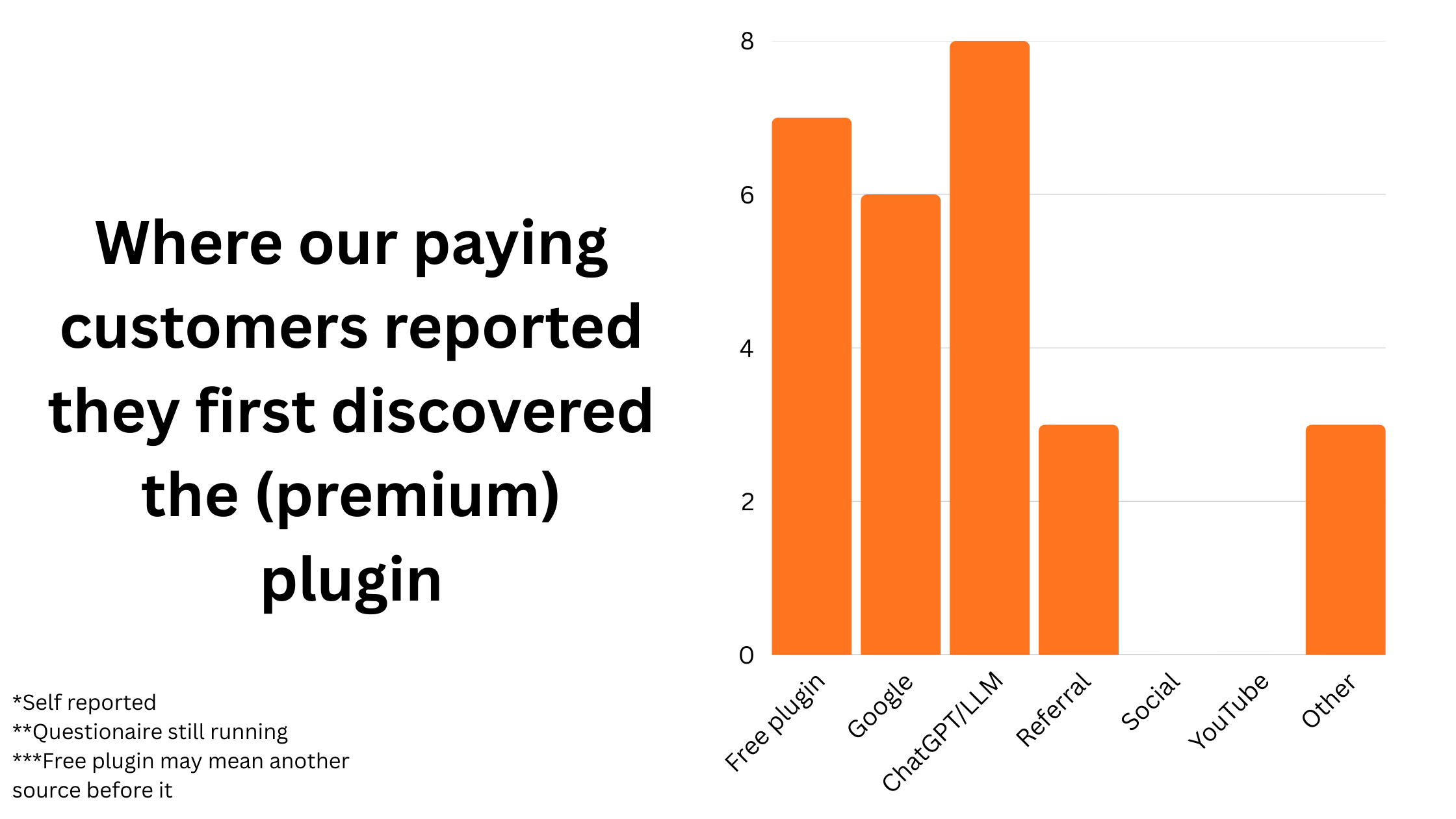
One particularly interesting signal came from a survey we ran on our thank-you page. While this form hasn’t been running very long yet, so far, the most common (self-reported) way our customers discover our products is through LLMs…
Email and video still work (when used deliberately)
Output doesn’t equal results, but it can still be useful to look at activity in context.
Across our social channels and YouTube, we averaged around four posts per day in 2025, spanning platforms like YouTube, Facebook, Instagram, BlueSky, X, Threads, Pinterest, and LinkedIn. Together, this drove roughly 165,000 views across all channels, with video accounting for more than half of that.
On the email side, we sent out 43 newsletters throughout the year. Average open rates came in at 36.3%, with an average CTR of 1.93% (a CTOR of 5.33%). Performance varied widely by audience and intent, with reactivation campaigns consistently underperforming compared to emails sent to active users, which is a useful reminder that context matters more than volume.
Conferences, events, and getting out of the bubble
In 2025, we sponsored two events: one in-person (WordCamp Europe) and one online (PageBuilder Summit). Beyond that, we attended a total of seven conferences and events, including five WordCamps or meetups, as well as two non-WordPress conferences: DMEXCO and SaaStock Europe.
These events were valuable not just for visibility, but for partnerships, networking, and learning. For me personally, non-WordPress conferences have become one of the most effective ways to force learning and broader thinking, and avoid getting stuck inside the WordPress bubble.
Over the year, our CEO Robert Abela also gave nine talks across in-person and virtual events, podcasts, and panels. You can read more about how he experienced 2025 in his post on his personal blog.
Community and brand building still matter
Not everything we worked on in 2025 was aimed at immediate growth. Some initiatives were focused on long-term brand, trust, and contributing back to the ecosystem.
Two of the most notable examples were our yearly security survey and our collaboration with Roadmap.sh on their WordPress roadmap.
Our yearly security survey
Once a year, we run a security survey to help people in the WordPress ecosystem, from product builders to agencies and solo developers, better understand the state of WordPress security.
In 2025, we received 264 responses. The resulting post, panel discussion, and related promotions drove tens of thousands of impressions, along with a number of important mentions and citations for the brand.
WordPress roadmap (roadmap.sh)
We were also lucky enough to work together with Roadmap.sh on their first-ever WordPress roadmap, which was published a few months prior to writing this post. The goal was to help new WordPress developers better understand the ecosystem and how to enter it, which was a project that aligned well with our longer-term view on community and education.
Want more?
If you’re interested in a broader view of what we shipped, learned, and changed at Melapress in 2025, check out our end-of-year post on check out our end-of-year post on the Melapress website.
Ready for 2026!
2025 was a year of change, learning, and foundation building. We didn’t chase every opportunity and, in some cases, deliberately slowed down to gain clarity, fix blind spots, and put better structure in place.
Going into 2026, we’re in a very different position than a year ago. We have a clearer understanding of the business, better reporting, stronger processes, and a much more grounded view of where marketing can have the most impact.
There’s still plenty to improve, but the focus for 2026 is clear: fewer distractions, deeper bets, and better use of the foundations laid over the past year.
I’m looking forward to what’s next.